
Essay on the True Manner of Playing the Clavier
Translated by Tobias Plebuch (Part I) and Derek Remeš (Part II)
Edited by Mark W. Knoll
Table of Contents
Essay on the True Manner of Playing the Clavier
The publishing project Carl Philipp Emanuel Bach: The Complete Works (CPEB:CW) released its final printed volume in 2024. Included among the 117 volumes is a new critical edition of Bach’s seminal treatise Versuch über die wahre Art das Clavier zu spielen, one of the most important sources of information on performance practice in the eighteenth century. The German text established for the edition includes for the first time all of the material that Bach produced over the course of nearly 35 years. The complex publishing history of the treatise during Bach’s lifetime is described in detail in the introduction to CPEB:CW, VII/1, pp. xix–xxx, and need not be repeated here. It suffices to note that Bach began work on the treatise in the early 1750s (if not earlier) and that the original single volume was eventually expanded to two volumes, and that each volume went through multiple editions (with multiple publishers). At various points along this timeline Bach added new material and made changes to existing material, including just months before his death. No previous edition in any language has taken all of this material into consideration.
With our establishment of the complete German text it seemed logical to consider a new English translation to supplement William J. Mitchell’s translation from 1949. Mitchell attempted to include as much of the disparate material of the various German editions as possible into his translation, and largely succeeded, but he was not aware of all of it, and he didn’t always make clear from which edition a particular passage was taken. Furthermore, Mitchell took some liberties in his approach that make comparisons with the original German editions somewhat difficult.
The most egregious example is Mitchell’s renumbering of Bach’s chapters. Since the two volumes of the treatise were conceived independently, Bach numbered each volume separately. In Part I there are three chapters, with the second chapter further subdivided into nine sub-chapters (Bach’s terms are “Haupstück” for the main chapters and “Abtheilung” for the sub-sections). In Part II there are 41 chapters, starting again at Chapter 1, some of which are further subdivided (here Bach used the terms “Capitel” and “Abschnitt”). Mitchell through-numbered both volumes, with the three original chapters from Part I as numbers 1–3, but with the 41 chapters of Part II condensed into just four, numbered 4–7.
Even within chapters Mitchell made changes to the organization of the treatise. Bach’s musical illustrations often included multiple examples for the same concept, which he would usually label with letters. Since in eighteenth-century German the letters “i” and “j” were considered only variations of the same letter, when Bach had more than nine examples his labels would proceed from “i” to “k” with no “j” in between. Mitchell insisted that there must be a “j” and relabelled all examples from “k” on, so that those examples are off by one when compared to Bach’s originals.
While Mitchell’s translation itself is, on the whole, well done, and has served generations of English-speaking students well over the years, his rather free translating style occasionally glosses over some of Bach’s admittedly complex prose, and he sometimes even omits especially difficult or ambiguous passages completely. Thus, a need for a more literal translation, along with the availability for the first time of a complete critical edition of the German text, led CPEB:CW to commission this new translation.
The translation is intended to be dynamic and flexible, not only by involving a small team of native German and English speakers from the beginning (as opposed to Mitchell’s single-person approach), but by incorporating modern forms of collaboration and distribution not available to Mitchell. By making the translation available as a website, it can immediately gain a large and international audience, some of whom may have particular insights and expertise that can add to the value of the project. We are encouraging input from such interested parties by providing a “Send feedback” link on every page of the web site. While the translation itself might not be altered based on such input, we plan to include viable alternate viewpoints or additional information in a corpus of commentary that can be continuously expanded. We will, of course, correct any outright errors of translation or transcription.
Our new translation is being made available in the form of a website that was created using only WC3-validated HTML5/CSS user-facing code in order to offer compatibility with the largest possible array of devices, including not only desktop and laptop computers, but also tablets, any e-reader with a web browser, and even mobile phones when nothing else is available (not recommended for long-term use!). Much of the development of the site occurred on iPads, and the luxury of having the text and the music examples on a single device that fits nicely on the music desk of a keyboard instrument can only be recommended to our readers.
Without the constraints of traditional book publishing, and the constant concern about page count, our translation can be more inclusive than Mitchell’s. First and foremost, this extends to the inclusion of both the German and English texts in parallel. Of course, in the analog world, one could have a copy of the German original open alongside Mitchell’s translation to create a similar effect, but, because of Mitchell’s interventions outlined above, it might not always be clear where to look in the German text. Additionally, before the publication of our critical edition of the original text, the most easily accessible form of the German was Wolfgang Horn’s facsimile edition (Bärenreiter, 1994). This gives the 1753 and 1762 first editions of the two parts in facsimile, with most of the additions and changes of the later editions given in an appendix, thus requiring more jumping back and forth to see what Mitchell was translating. Our presentation allows for nearly effortless comparison of the German and English texts.
Bach organized his chapters into numbered paragraphs, and the website reflects this organization by placing each paragraph, no matter how long or short, onto its own web page. Furthermore, since English translations of German texts tend to employ fewer (and shorter) words, parallel translations will quickly get out of sync, such that the German text being translated is often found considerably further down the page than the English, making comparison difficult and awkward. Our presentation attempts to ameliorate this by dividing longer paragraphs into sub-paragraphs, inserting line breaks after every sentence or every few sentences, depending on context, to keep the two languages roughly at the same level on the page.
This has the further advantage of “de-densifying” the material. Bach presents a lot of material in a constrained space and in rather direct language. This can easily lead to information overload, and having the extra space within paragraphs gives the material a chance to breathe a little more.
The design of the Versuch translation website follows the conventions established by the cpebach.org site, of which it is a part. The same parchment background is used, with black typography for the main text, and with the same dark-red link color. Typography in a purple/blue color denotes commentary text, either original commentary by Bach in footnotes or our added commentary on separate pages.
Navigation of the site is provided by previous/next links to jump from one paragraph to the next. The treatise’s title at the top of each page is also a link to the Versuch “Table of Contents” page, while a link at the bottom of each page takes you to a listing of all paragraphs within the current chapter, so that moving within and among chapters is always a matter of just a few clicks. To return to the main cpebach.org site, navigate to the Versuch “Table of Contents” page, then click on the “Carl Philipp Emanuel Bach The Complete Works” banner. The “Search” link found on each page takes you to a search entry field where both German or English terms and phrases can be entered (enclose phrases in quotes to find just the phrase instead of each individual word in the phrase). Clicking anywhere in the text snippets in the found results will take you to the corresponding full paragraph in the Versuch.
In Part I of his Versuch, Bach published the engraved musical examples in a separate supplement. In Part II, he was able to incorporate them into the text as type-set music, but he often placed a large group of examples only at the end of a long paragraph, in order to maximize the amount of content on the page. In either case, the reader was often forced into much jumping back and forth. Our translation places the examples as close to where they are referenced in the text as possible, usually directly within, instead of always at the end, of paragraphs, which also helps to break up the text into more manageable segments.
Many of Bach’s musical examples were originally presented in a highly condensed format, due to technical and space constraints.
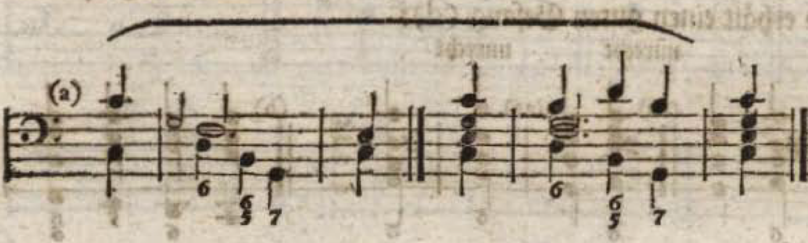
CPEB:CW, VII reproduced this original format, which often gives the melody, bass line, continuo figuration, and realization all on a single staff.
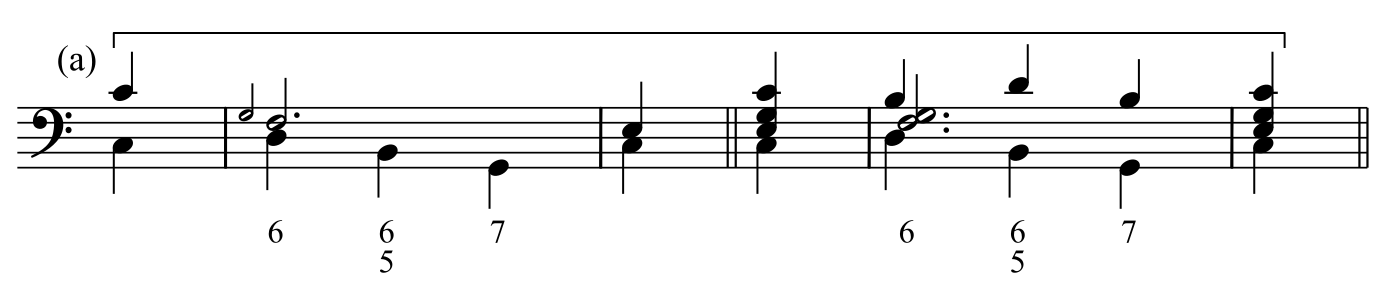
The new translation expands such examples for which a 3-stave realization was intended,
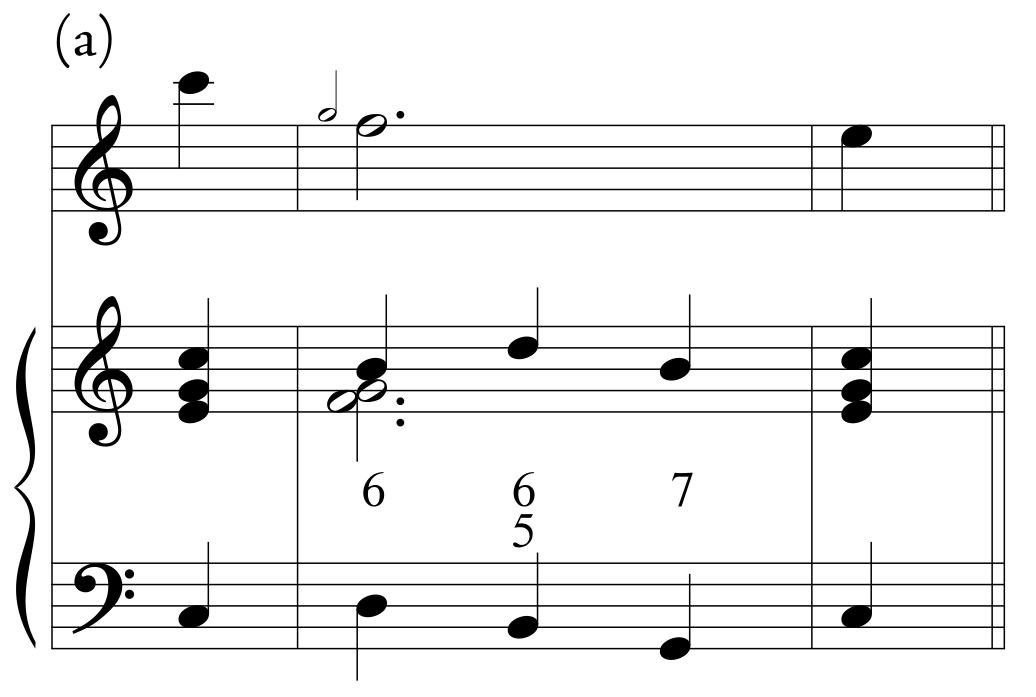
as well as quite a few for which a 2-stave realization was intended, where it makes reading easier.
Bach’s labelling of his musical examples is rather inconsistent. In the text of Part I he provided cross references to the examples in the separate supplement, but, since the musical examples were incorporated into the text in Part II, he did not need such references there. Apart from this high-level difference between the parts, however, in both parts he used multiple, sometimes overlapping, systems to identify sub-examples; that is, multiple short snippets that are grouped together to demonstrate a single concept. Usually these are just run on, with only a double barline indicating where one ends and the next begins. If he wished to point out something in particular about one of the snippets, though, he needed a way to refer to it apart from its companions. For this he sometimes used letters, sometimes numbers, occasionally a combination of both, along with asterisks, crosses, and parentheses if more granularity was needed. The translation maintains Bach’s labels and sub-labels, but also provides a separate, through-numbered labelling system that corresponds to the one used in CPEB:CW, VII.
Bach is also inconsistent in his placement of continuo figures in his musical examples. Sometimes he placed them above the staff, sometimes below, and often in the middle of the staff when space was tight. For our realization of the musical examples, we place continuo figures below single-staff examples to avoid conflicts with fingering numbers, dynamics, and other symbols that are placed above the staff; in multiple-staff examples, we place the continuo figures above the bottom staff.
For inflected continuo figures, Bach mainly used the modern convention of interval first followed by the inflection (e.g., 4  ). For lowered 5, 7, and 9, however, Bach reverted to an older system that reverses the order (e.g.,
  5). Our edition and translation normalizes these (e.g., 5 ) to match the other figures.
In the German text we maintain Bach’s original orthography, even where it is inconsistent. Only at the very end of the eighteenth century, and more so in the nineteenth, was there an impetus towards a modern “Rechtschreibung” in written German, such that Bach’s inconsistencies (from our viewpoint) were accepted as normal practice at the time. For example, sometimes he writes “Zeitmaß,” but mostly “Zeitmaaß,” or “Terzien/Tertien” (even in the same paragraph! cf. I:1,§70) or “Dissonanzen/Dissonantien.”
Where Bach used bold text for emphasis, we instead use italic in both the German and English texts. Occasionally, in the translation we will include a German term or phrase in brackets even though it is of course already present in the parallel German text. This is intended for readers who are not versed in German, but who may wish to become familiar with at least a few concepts in the original language, such as “portato [Tragen der Töne].”
One of the advantages of presenting the translation in the form of a web site rather than a printed book, is that it is possible to continue to alter it after publication. In our case, we envision adding further commentary as needed. This might include any suggestions, corrections, or relevant material contributed by our readers.
The commentary for establishing the German text can be found in CPEB:CW, VII and is not duplicated here. But any further commentary, such as explanations, references to other treatises or pieces of music, or just interesting tidbits, have been (and will be) added as links to separate web pages. We decided to keep the commentary on separate pages, rather than in footnotes, because this allows us to include longer, more complex material, which might include music examples, images, or other content that would be cumbersome to include in a footnote. Plus, footnotes on web pages tend to cover content on the main page. Having the commentary in separate pages enables the user to have two unobstructed windows open simultaneously, one with the main content and the other with the commentary, so that Bach’s original text is clearly distinguished from any added material.
Mark W. Knoll
Our goal in this translation is to provide a more literal alternative to Mitchell’s work, while allowing readers who are comfortable in both German and English the opportunity for direct comparison. We aimed to remain as true as possible to the original German, both in content and structure, while preserving clarity in English. We adhere mainly to American English (e.g., “8th notes” not “quavers”; “color” not “colour”; “measure” not “bar”; etc.), but allow some British usages where they are closer to Bach’s terms (e.g., “half/whole tone” instead of “half/whole step” for “halber/ganzer Ton”).
Naturally, as for any translation, compromises are often necessary. For instance, “falsche Quinte” could have been translated literally as “false fifth,” but we prefer the more idiomatic “diminished fifth.”
Two terms in the treatise’s title, Versuch über die wahre Art das Clavier zu spielen, deserve special mention. The first is “Art.” This is often translated from the German as “art” (as Mitchell has done), perhaps as a parallel to L'art de toucher le clavecin, Couperin’s 1716 treatise, which Bach certainly knew. However, the proper sense of “Art” in German is “Weise;” that is, “manner” or “way of doing things.” Bach certainly considered good keyboard playing an art, but nothing in his treatise suggests that he was thinking of that sense in his title. His intent is clear: the treatise was a practical instruction manual, whose adoption by teachers (and self-learners) would standardize and improve the teaching of keyboard playing. There were German treatises that did refer specifically to the “art” (German “Kunst”) of keyboard playing, such as Marpurg’s Die Kunst das Clavier zu spielen, which was published in Berlin just two years before Bach’s treatise. Bach’s “wahre Art” may thus have a polemical undertone against those who would inject keyboard instruction with too lofty ambitions.
The second term is “Clavier.” Since the modern German “Klavier” refers almost exclusively to the piano, Bach’s usage in his title is often translated as “piano.” This is anachronistic, however. In Bach’s day, “Clavier” meant any musical instrument that had a physical keyboard with twelve keys per octave. These included the clavichord (Bach’s preferred instrument for solo playing), the harpsichord, the still-fairly-new fortepiano, the organ, or various experimental designs, such as the “bowed keyboard” and combined harpsichord/fortepiano or harpsichord/organ instruments. Thus, a more general term than “piano” is needed. The English “keyboard” is sometimes suggested as a more general alternative, and this may have been plausible in 1949 when Mitchell used it, but in recent decades “keyboard” has become almost synonymous with “electric keyboard” or “computer keyboard,” neither of which is included in Bach’s “Clavier.” After much consideration and debate, we have decided to stick with “clavier” as a pseudo-English term that conveys the proper nuance, since it has gained a foothold in English through Sebastian Bach’s two collections of “The Well-Tempered Clavier.” When Bach needs to refer to a specific instrument, he uses “Clavichord,” “Cembalo” (or “Flügel”),” “Fortepiano,” or “Orgel” (or “Mr. Hohlfeld’s instrument” when referring to the bowed keyboard).
We only use the term “clavier” in its nominative singular form, though. The German plural “Claviere” we give as “keyboard instruments,” and any adjectival use, such as “Clavierstücke” or “Clavierspieler” we give as “keyboard pieces” or “keyboard player.”
For other unusual, outmoded, or ambiguous terms that Bach uses, we include a glossary (linked to from the “Table of Contents” page), but a few terms merit some discussion here. The (usually) wooden levers integral to the clavier are called in German “Tasten,” which we translate as “keys.” To avoid confusion with the other usage of “keys” in English we usually translate the German “Tonart” as “tonality” rather than “key.”
In the standard arrangement on keyboard instruments of twelve keys per octave, there are seven keys on the lower row and five on the upper row. Bach refers to the keys on the upper row somewhat confusingly as “halbe Töne” (“half tones”), referring to the distance from their nearest keys on the lower row. Directly translating Bach’s “halbe Töne” as “half tones,” however, inevitably leads to confusion with the interval of a half tone. On modern pianos, the upper row can safely be called the black keys, and the lower row the white keys, but that won’t work for the instruments that Bach had in mind, because the white/black (or light/dark) color pattern was almost always reversed compared to a modern piano. Thus, we have settled on “raised keys” for Bach’s “halbe Töne” to indicate their raised position above the lower row.
Bach usually makes a slight distinction between “Manieren” and “Verzierungen.” With the former he means the specific standardized way of ornamenting a note, usually indicated by a common symbol, and with the latter he generally means the overall concept of embellishing music. Thus, we translate the first as “ornament” and the second as “embellishment.”
The translators would like to thank the members of the committee established to review the translation—Ulrich Leisinger, Peter Wollny, Christoph Wolff, Paul Corneilson, and Mark W. Knoll—for their careful reading of the text and for their many helpful suggestions. Paul Rabin also read the entire text with utmost care and with an eye towards grammatical clarity and consistency. Wilkins Poe of the Packard Humanities Institute provided essential technical support, in particular with the search functionality.
Tobias Plebuch
Derek Remeš
Tobias Plebuch is lecturer at the department of musicology at Uppsala University in Sweden. He holds a diploma in music education, and a PhD and postdoc (habilitation) degrees in musicology. Prior to his appointment at Uppsala, he held research appointments in Freiburg, Berlin, and Stanford, California. His primary areas of teaching and research are 18th-century music (especially C.P.E. Bach), music in audiovisual media, and K-pop. For Carl Philipp Emanuel Bach: The Complete Works he edited the three-volume critical German edition of the Versuch über die wahre Art das Clavier zu spielen. For more information, please visit www.tobias-plebuch.de.
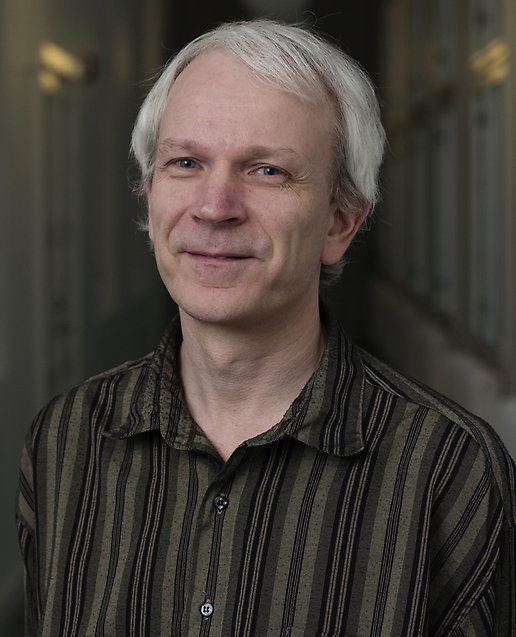
Univ.-Prof. Dr. Derek Remeš, born in 1986 in the USA, is Professor of Music Theory at the Technical University in Dortmund, Germany. He holds a PhD in Music Theory from the Freiburg University of Music in Germany, where he completed a dissertation in 2020 on J. S. Bach's compositional pedagogy (summa cum laude), which won the Society for Music Theory's dissertation award. Mr. Remeš has published in Music Theory Online, Eighteenth-Century Music, Early Music, the Zeitschrift der Gesellschaft für Musiktheorie, and Musik & Ästhetik, and he has served as editor of the journal Music Theory and Analysis since 2019. He has presented numerous lectures in the USA, Europe, and China. For more information, please visit www.derekremes.com.