 Previous §
Zweyter Teil | Part II


| Previous § |
Essay on the True Manner of Playing the Clavier Zweyter Teil | Part II |
Next § |
| 7. Capitel. Vom Terzquartenaccord 1. Abschnitt. |
Chapter 7. On the 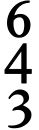 chord chordSection 1. |
§. 9. Wenn die große Sexte die übermäßige Quarte und die kleine Terz bey sich hat, so liegt gemeiniglich vorher entweder die Quarte oder die Terz. Bey dem Exempel (a) werden sie beyde, durch eine Vorausnahme des Durchganges (b), frey angeschlagen. Die Terz tritt bey der Auflösung herunter, und die Quarte hinauf. Die Grundnote kann gebunden seyn, und auch nicht: sie geht aber hernach um eine Stufe herunter. Die Signatur hierzu ist  , ,  oder oder  . Wer den harten Dreyklang von der Secunde weiß, der kann auch diese Aufgabe leicht treffen; er darf nur statt der 2 die 3 nehmen. Wenn man dreystimmig accompagnirt, so bleibt die 6 weg, nur bey (x) nicht: . Wer den harten Dreyklang von der Secunde weiß, der kann auch diese Aufgabe leicht treffen; er darf nur statt der 2 die 3 nehmen. Wenn man dreystimmig accompagnirt, so bleibt die 6 weg, nur bey (x) nicht:
|
§9. When the major sixth has the augmented fourth and minor third with it, then usually either the fourth or the third is prepared. In the example at (a) below, both intervals enter without preparation, enabled via an anticipated passing tone, as shown at (b). At the resolution the third descends by step, the fourth ascends by step. The bass note can be tied, or not: either way it descends by step subsequently. The figuration is , , or . Whoever is familiar with the major triad a second above the bass can easily realize these examples; one must only take the 3 instead of the 2. If one accompanies in three voices, then the 6 is omitted, except at (x):
|
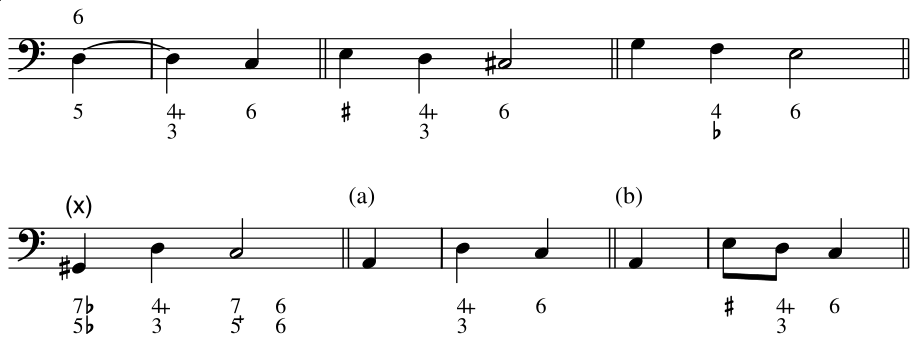
Ex. II:121 |
|
| Previous § |
Jump to any § in Chapter 7 | Next § |
Translation © 2026 The Packard Humanities Institute